
Glare, Gamma, and the Ghost in the Scanner
Film scanners don’t just copy film; they interpret it. Our research demonstrates how tonal curves and lens glare can subtly alter the output of a digitized film, even when using professional equipment. By testing the same film across 12 European archives, we uncovered how different scanners and settings impact image fidelity. Understanding these hidden variables is crucial to creating more accurate digital restorations and preserving the authentic look of film for future generations.
Alice Plutino and Luca Armellin
9/16/20252 min read

The Hidden Editing of a Film Scanner
A film scanner is not a neutral “camera.” It combines light sources, lenses, sensors, and software, and many of these components are proprietary or undocumented. Together, they shape the image before you even see it.
We call this in-camera processing: everything that occurs inside the scanner, from gamma encoding to LUT application. These steps are crucial, but because they are not always transparent, two scanners can produce very different digital versions of the same film.
Why Glare Matters
Glare (or flare) is an optical effect caused by light scattering inside the scanner’s lens system. You might not notice it as a visible artifact, but it’s always there, subtly lifting the darkest areas of an image and compressing the film’s dynamic range.
In our tests, we found that glare is a systematic and unavoidable factor in tonal accuracy (the only exceptions are for linear systems). In other words, no matter how good the scanner is, glare prevents a perfect one-to-one reproduction of the original film.
The performed tests
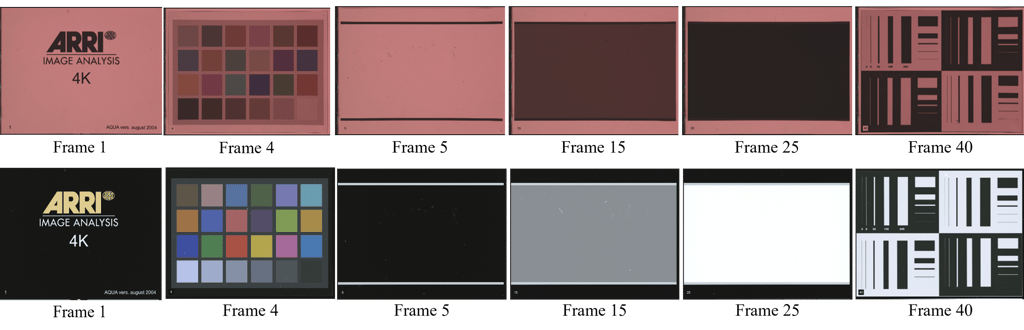
To explore these effects, we digitized a standardized 35mm ARRI AQUA test film in 12 different European labs, each using their own scanners and standard archival workflows. We then compared the digital outputs to spectrophotometric measurements of the film’s optical density.
This allowed us to measure:
Tone distribution: whether the scanner records tones linearly (like light transmission) or logarithmically (like print film densities).
Context glare: how much a bright area affects neighboring dark areas.
What We Found
No two scanners behaved exactly the same. Even scanners of the same model, used in different labs, produced slightly different tone curves.
Metadata can be misleading. DPX files sometimes declare a linear transfer, but the resulting image behaves like a logarithmic one, and vice versa.
Glare is unavoidable but variable. Some scanners had significantly lower glare levels, while others exhibited noticeable shadow lifting.
Maintenance and calibration matter. Differences may be linked not just to technology but to how scanners are configured, maintained, and operated.
Why It Matters for Preservation
These findings raise important questions:
What is the goal of digitization: to reproduce the film’s physical properties, to match how it looks to the human eye, or to create a pleasing digital image?
How can archives ensure consistency when different scanners produce different tonal responses?
Should glare compensation become part of standard digitization workflows?
Our Takeaways
Perfect reproduction may be impossible, but awareness is the first step toward better practices. We suggest:
Characterizing scanners before large-scale digitization projects.
Collaborating with manufacturers and scientists to increase transparency and refine tools.
Educating archivists and practitioners about glare and its impact, so they can make informed decisions about scanning settings and post-processing.
By understanding these hidden variables, we can move closer to producing digital versions of films that are not just visually pleasing but also faithful to the original materials, an essential step for the preservation of our cinematic heritage.
This post is based on our peer-reviewed publication: Plutino, A., Armellin, L., Sarti, B. et al. Tonal distribution and glare assessment in cinematographic film scanners. SIViP 19, 976 (2025), DOI: 10.1007/s11760-025-04569-8
You can read the full article here: https://doi.org/10.1007/s11760-025-04569-8
Film digitization is a cornerstone of audiovisual preservation.
But have you ever wondered how faithfully a scanner “sees” a film?
When we digitize a reel, we often assume that the resulting file is a perfect copy. In reality, the process is far more complex. Our recent research sheds light on two critical but often overlooked aspects of film scanning: tonal distribution and lens glare.
© 2025. All rights reserved.
Contacts:
© Imageese s.r.l. - P.IVA 14454360968
Startup innovativa ai sensi del D.L. 179/2012
Sede legale: Via Tazzoli, 7 San Vittore Olona (Milano) - Italy
Registro delle imprese di MI - 2785528
PEC: imageese@pec.it